


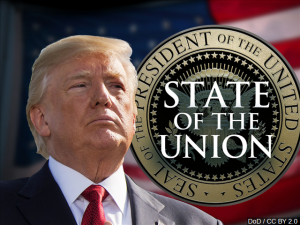
A Virginia Tech professor analyzed Tuesday night’s State of the Union Address, the longest in American history, and what it means for the upcoming midterm elections. WFIR’s Conner Arthur has that story:
President Donald Trump’s first State of the Union address of his second term was the longest in American history, but a Virginia Tech expert says the nearly two-hour spectacle likely failed to move the needle for voters or vulnerable Republican lawmakers.
The Tuesday night address lasted one hour and 47 minutes, characterized by a campaign rally atmosphere and frequent standing ovations. Karen Hult, a political science professor at Virginia Tech, noted the speech prioritized optics and guest recognitions over specific policy proposals.
Spectacle Over Substance in the Chamber
The president maintained a boastful tone throughout the evening, beginning with “U.S.A.” chants before introducing the Olympic gold medal men’s hockey team. Hult observed that Trump appeared less reliant on a teleprompter than in previous appearances. He used the platform to list achievements including a “secure border,” decreasing inflation, and “ending DEI.”
Despite the high-energy presentation, Hult said the address lacked the legislative “laundry list” typically expected from such speeches. Instead, 12 invited guests drove the narrative, a technique Hult traced back to the Reagan administration. These guests included survivors of Jeffrey Epstein’s sex-trafficking network and the U.S. hockey team goalie, who received the Medal of Honor.
Midterm Implications and Audience Fatigue
The timing of the speech is critical as the nation prepares for midterm elections. Hult suggested the president missed an opportunity to provide a “stronger reason” for Republicans in vulnerable seats to use on the campaign trail. The address focused more on personal achievements than on the specific concerns of struggling voters, such as the cost of rent and gas.
“It seems doubtful that the address changed any minds or will have much policy impact,” Hult said.
Nielsen ratings indicated a significant decline in public interest. Approximately 28 million people watched the address across major networks like CNN, Fox News, ABC, NBC, and CBS. This represents a drop of more than 8 million viewers compared to the president’s address to Congress last year.
Shifting Habits in a Digital Era
Hult expressed surprise at the viewership decline but noted that technology has fundamentally changed how Americans consume political content. Many people now rely on streaming services, live fact-checking, or social media highlights rather than watching a full broadcast.
The president’s own posts on Truth Social provided a “Reader’s Digest version” of the event for those unwilling to commit to the record-breaking runtime. Hult suggested that after a difficult week, many possible voters simply tuned out the lengthy rhetoric.
Looking Toward the 250th Anniversary
The president concluded his remarks by looking ahead to the 250th anniversary of American independence on July 4, 2026. While this patriotic framing may appeal to his core supporters, Hult maintained that State of the Union addresses rarely have a direct impact on public approval ratings. As the midterm cycle intensifies, the lack of advocacy for specific legislative goals may leave some members of the House and Senate concerned about the political makeup in November.
The post Virginia Tech expert analyzes longest State of the Union address in history first appeared on News/Talk 960-AM & FM-107.3 WFIR.
